




Introduction
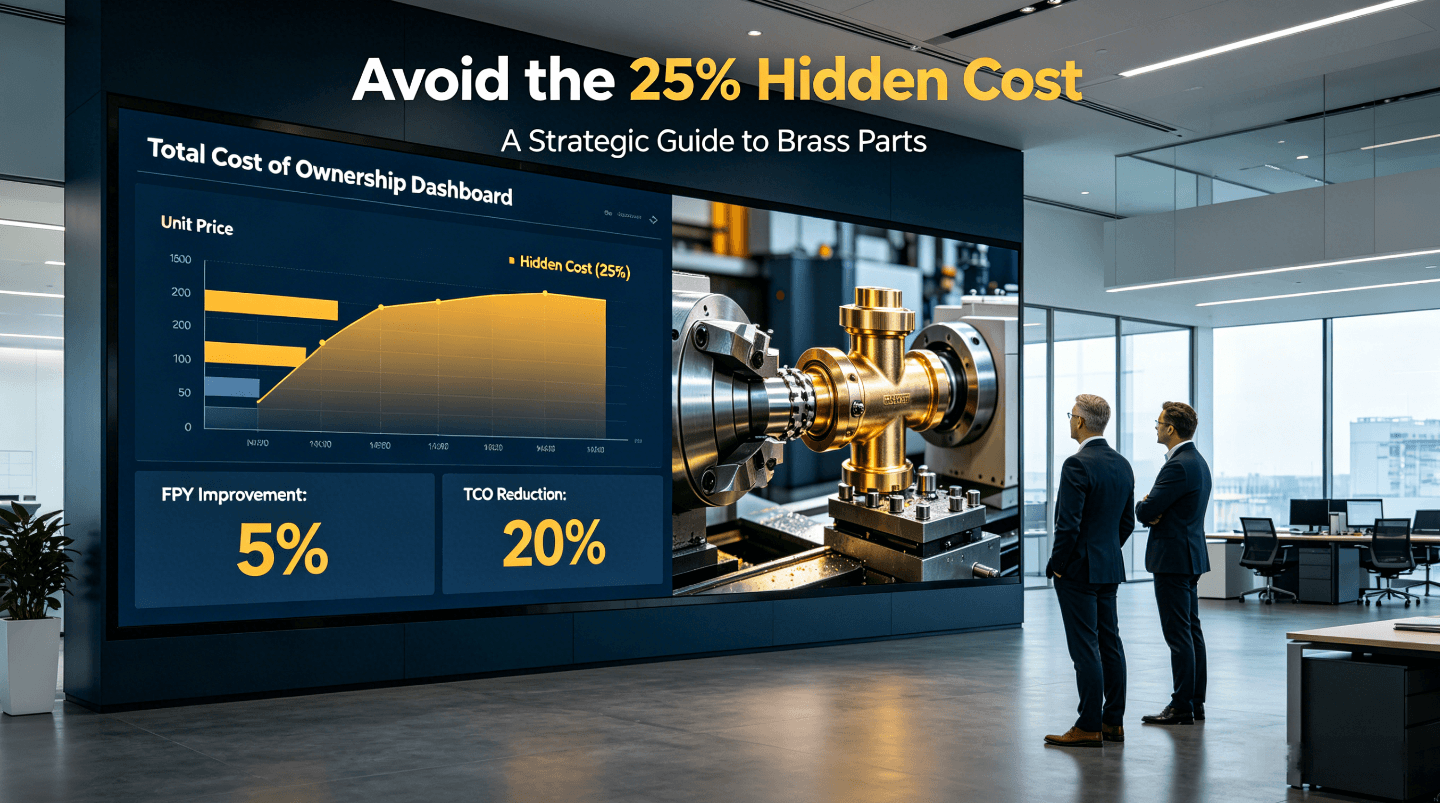
In the manufacturing sectors that require highly engineered components, from valves to top-tier consumer goods companies. The acquisition of brass CNC turned parts becomes nothing but a game of comparing prices per unit. This single-minded approach leads to a plethora of hidden costs. Such as production downtime due to non-uniformity in input material quality. Failures from seal leakage during field use, and delays resulting from inadequate manufacturing capabilities at suppliers’ end. In aggregate, these hidden costs become a “hidden tax” that reduces a project’s total cost by about 25% or more.
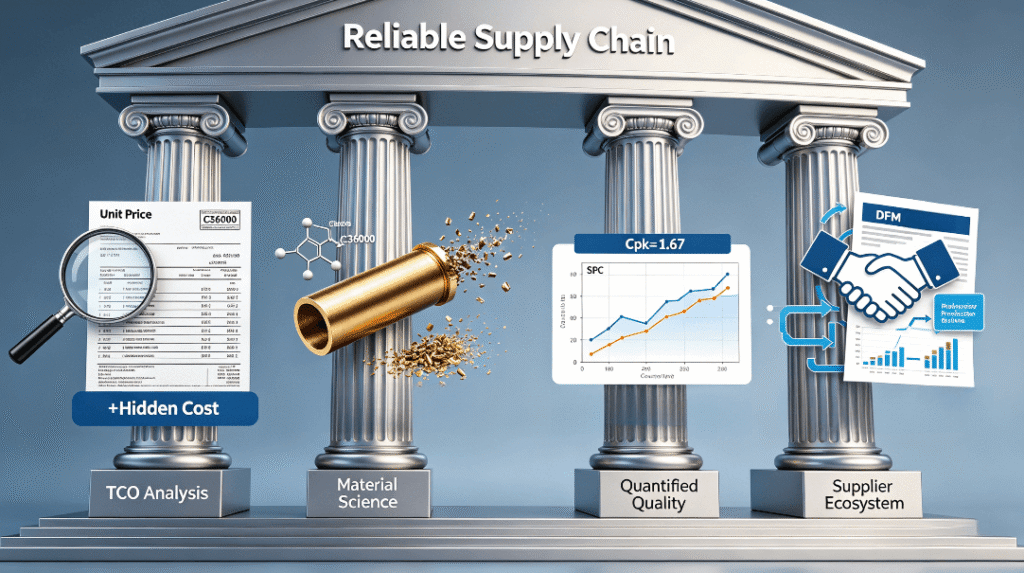
This happens because the part procurement decision is made in isolation. Without considering the overall strategic value of ensuring reliable supply chain management. The conventional set of criteria for making the right decisions in part procurement focuses entirely on the bottom-line metric of “unit price”. While ignoring the fundamental factors that contribute to a higher Total Cost of Ownership (TCO). This article outlines a four-pronged strategy for brass component procurement in order to maximize value creation.
What Is Included in the True Cost of a Brass Part Aside from Unit Price?
Taking into account more than just the invoice price is the first step towards achieving true strategic procurement. Among other things, the true cost includes the price of internal inspection, production loss due to scrap, inflated carrying costs of excessive safety inventory, and finally, and by far, the most costly factor – brand reputation damage due to failures after installation. A full TCO analysis demonstrates that an increase in unit price by 10% accompanied by a 5% improvement in FPY may reduce total costs by more than 20%.
- Breaking Down the Total Cost of Ownership: In addition to the unit price on a purchasing invoice, there are additional costs to be considered as well. Internal costs include the salaries and machines used to inspect incoming parts, idle time of the machine. When producing a batch of nonconforming components, as well as disposal costs. Also, excess inventory, which is held in case of irregularities in supplying process, costs money as well.
- The Cost of Quality Problems Is Often Exponential: The worst kinds of costs are external and exponentially greater. Component failures during assembly result in expensive stop-ship orders, whereas failures in the field can cause large-scale product recalls and warranty claims in medical and automotive uses. Sourcing from a supplier lacking a solid quality management system transfers the potential for an unquantifiable amount of risk directly into the buyer’s financial books. In some cases, one single occurrence can dwarf years’ worth of saved money per piece by sourcing through a lower-priced supplier.
- Using Data to Make Better Decisions: Implementing the concept of Total Cost of Ownership changes the game entirely when it comes to procurement. Instead of simply asking for price per thousand, it is now vital to ask for hard numbers regarding FPY, process capability metrics (e.g., Cpk), and past performance regarding on-time delivery of similar components. This allows for comparing not just a starting price but a more predictable and quantifiable TCO. As far as the technical aspects of cost and quality, a primer on brass CNC turned parts is a must-read.
In What Ways Are Material Properties of Brass Directly Converted to Business Advantages?
Material properties of brass are not merely data points but rather direct factors driving business results. For example, the exceptional machinability of certain alloys, such as free-cutting brass C36000, leads to faster processing times, lesser tool wear, and improved surface finish quality. All of these result in decreased production costs per unit, leading to increased productive capacity, which becomes a clear business edge in terms of delivery time.
- Machinability as an Economic Lever: The intrinsic advantages associated with brass CNC machining arise due to its excellent chip creation and lower cutting forces. This means that brass is able to process at higher rates than most other materials, saving energy and time per unit produced. Additionally, lower tool wear saves on maintenance costs and reduces machine idle time between tool changes, boosting efficiency.
- Reduction in Secondary Cost of Performance: Due to the self-corrosion-resistant nature of brass, together with its antimicrobial characteristics, the requirement for additional plating and other secondary processing becomes unnecessary, saving cost associated with such procedures. Furthermore, meeting industry regulations for specific types of products, such as medical equipment or the food processing industry, can be made easier due to the material’s natural resistance capabilities. In this way, cost is also reduced through avoiding potential liability issues.
- The Importance of Material Consistency: Material consistency is a major factor in guaranteeing predictability of performance of materials. Differences in material composition can cause changes in performance as well as machining capability. Using standardized alloys in the form of brass that meets SAE J404 specifications can ensure consistency in performance as well as consistency in machinability.
Is Precision Engineering a Quantifiable Risk Mitigation Approach?
Precision engineering and efficient quality systems are more than mere qualities; they are quantifiable measures that protect against risks. When assessing a supplier, it is crucial to analyze metrics such as the Statistical Process Control (SPC) chart for dimensions that require attention and the Process Capability Index (Cpk) for those dimensions. Rather than merely providing a certificate based on ISO 9001, a supplier must demonstrate the effectiveness of the quality management system through actual metrics.
1. From Certificates to Capability Indices
Whereas a quality certificate guarantees the presence of a quality management system, the process capability data proves its effectiveness. A Cpk value equal to or greater than 1.33 demonstrates the control of a manufacturing process and its ability to produce consistent quality parts within the specified limits. By analyzing the Cpk report for relevant dimensions for similar parts, one can gain a quantitative measure of the supplier’s capacity to manufacture precision brass parts.
2. Systematic Advantages of Industry-Specific Certifications
IATF 16949, apart from other certifications, demands advanced process tools like APQP and PPAP. These two techniques are both proactive measures that are designed to avoid design transfer issues and production ramp-up problems. To a supplier, this structured risk evaluation means recognizing potential problems before they turn into expensive errors, leading to fewer production issues and more reliable deliveries for the buyer.
3. Traceability as an Insurance Policy
With a fully-developed quality management system in place, full traceability from raw materials to the finished parts is ensured. Such traceability allows rapid pinpointing of the source of any deviation in quality. Traceability is essential for containment efforts and proper analysis of the problem. In regulated industries, traceability is not just a useful practice, but rather an absolute necessity due to the enormous liability of a buyer.
Does Your Supplier’s Ecosystem Help or Hinder Your Supply Chain Resilience?
It is the ecosystem of your supplier that determines its true value — its technical proficiency, ability to scale production, and clarity of communications. A supplier with experience in CNC turning services for OEMs will be able to work with you on DFM at the early stages of product development, refining the design of parts to minimize waste and avoid overly complex machining. Such engineering input will save you from expensive changes and delays down the line.
1. The Benefits of Early and Deep Collaboration
An innovative supplier sees your design plan as an opportunity to have a conversation rather than a strict order. By doing the DFM analysis, the supplier’s engineers will be able to advise on very small design changes like changing the radius or tolerance a bit. Such minor adjustments can greatly improve the ease of production and reduce costs without compromising the component’s functionality.
2. Scalability and Transparency as Strategic Strengths
Resilience of supply chains comes into play under conditions of demand fluctuations. The supplier ecosystem should prove its ability to scale its production capabilities – being able to increase or decrease its volume in an efficient way. Apart from the scalability, there is a question of transparency. Suppliers capable of providing timely information on production will allow for better inventory planning on the part of customers and eliminate all unnecessary work on the status updates.
3. Integration to Achieve Frictionless Value Chain
In the most developed supplier networks, these systems seamlessly blend into your internal processes. This type of integration might involve common project management systems, electronic data exchange in order and forecast processes, and even quality reporting. Opting for a partner that provides end-to-end OEM CNC turning services in an environment like this elevates procurement beyond simply procuring goods; it turns the relationship into a value chain integration effort.
From Prototype to Volume Production: What Should You Do to Prevent Quality Issues During Scaling Up?
The transition from prototypes to mass production often presents several hidden expenses. Among them are poorly designed tooling, non-validated parameters of production processes, and an inadequate quality control strategy for mass production. Thus, a carefully thought out “ramp-up plan” with defined milestones such as a pilot run report from a supplier, production capacity data, and a refined control plan can make the scale-up process more manageable.
1. Prototyping as the First Step of Process Validation
In its essence, the prototyping stage must serve as a small-scale production run rather than the mere provision of the parts. In other words, prototyping can become a means of process validation and optimization. A good partner should provide you with information on all processes performed during prototyping including machining, testing, and inspecting. Based on this information, the production process plan may be created.
2. Ramp-Up Verification Checkpoints
Leaders need to confirm several critical checkpoints before signing off on mass production. The PPAP document provides all the evidence you need to prove that the supplier is capable of reproducing the quality of the sample in large volumes; measurement results and the production process will be documented and explained. Capacity checks require an assessment of the manufacturing process itself along with the staffing involved in it. Lastly, your scaled quality control plan should define more frequent statistical samples and automated inspection measures.
3. Securing Long-Term Stability of Your Manufacturing Partner
A good brass machining services provider will guarantee that your product performs consistently no matter how many units you order – from ten to ten thousand pieces. In order to ensure long-term stability, your partner must have advanced quality management practices in place, including Statistical Process Control (SPC), a solid calibration system for measuring tools, and a culture of ongoing improvement. It’s precisely the long-term stability of the manufacturing process that will preserve your competitive advantage on the market.
Conclusion
In today’s volatile business environment, decision-making about procuring precision brass CNC turned parts requires moving away from mere cost considerations. Through a strategic procurement process that includes Total Cost of Ownership窗口中 (TCO), material sciences, quantified quality engineering, and supply chain synergy, one can turn the procurement function into the backbone of an efficient organization that eliminates 25% of hidden costs.
FAQs
Q: Our company does small batching. Do we have too many constraints to implement such a strategic approach to procurement?
A: On the contrary! The approach scales well with any size of a manufacturing project. In a small batch production, the cost of each failure will be proportionally higher. Therefore, you need to ensure high First Pass Yield and Design for Manufacturing capabilities of your suppliers.
Q: How do I ensure the supplier’s actual quality capability, apart from the certifications?
A: Insist on proof of capability. Demand a Process Capability (Cpk) study on an important feature of a comparable component. Find out how they handle non-conformances and root cause analysis. A good supplier should be open about their processes and happy to prove themselves through real-life examples.
Q: Is brass a commodity metal? How much difference would the supplier make?
A: A lot of difference. Although brass is commoditized, its machinability is very process-dependent, and depends on the settings and tools used in machining. A good supplier understands this and tunes these factors for maximum efficiency and component performance.
Q: What is the most critical warning sign of an unsuitable partner for manufacturing precise brass components?
A: An unwillingness to participate in the Design for Manufacturability (DFM) process before providing pricing. If a company provides a quote without DFM recommendations only by analyzing the provided design, it is probably a transactional company, resulting in future costs associated with change orders and unexpected manufacturability problems.
Q: How do I reconcile cost pressure with the requirements of working with a reliable supplier?
A: Change the conversation from “price per piece” to “conformity cost“. Talk about your reliability goals, and ask prospective partners how they can deliver them. The quote of a more expensive company which includes extensive quality control and engineering assistance may have lower overall cost compared to yours.
Author Bio
The author is an expert in manufacturing strategy at LS Manufacturing, a leading organization that allows businesses to take full control of their manufacturing chain by overcoming any complexities in component development. With a solid basis in various certifications such as IATF 16949 and AS9100D, they ensure all the risks are considered while creating maximum value. Contact them now to get a structured evaluation of your existing component purchasing process.