




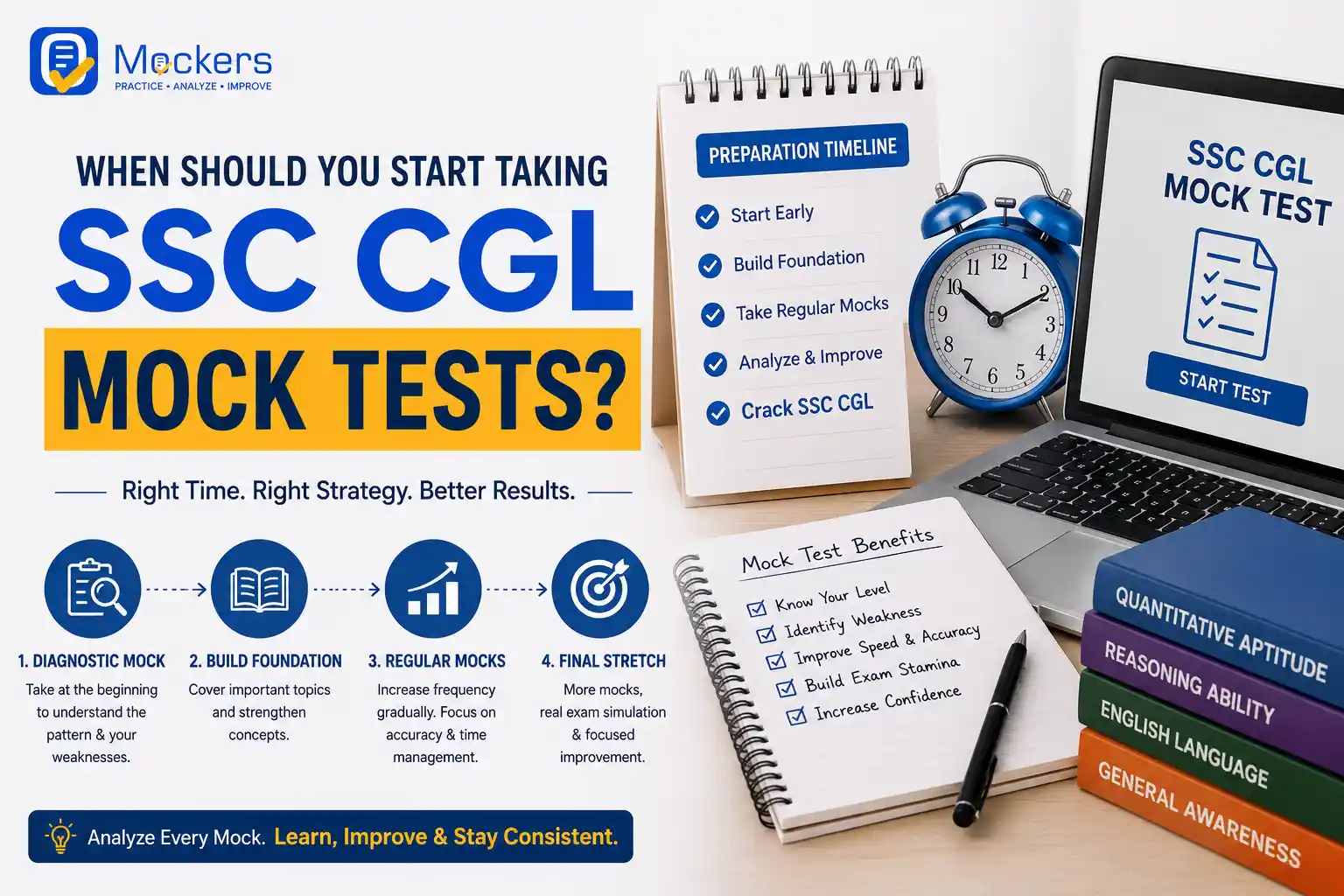
Ask advice from ten aspirants for the SSC CGL examination on the proper time of commencing mock tests, and you will hear two opposite opinions. Some believe it should be done at the very beginning, while others recommend doing it only after finishing the syllabus. Both options have their merits, and this ambiguity comes at a price – the former leads to low motivation due to poor performance, while the latter misses out on the opportunity of getting a map of weaknesses.
What is the proper timing? It depends on the type of the mock that will be used. Find out the difference.
Difference between Two Types of Mocks
The problem lies in the misunderstanding of the terms – in reality, there are two types of tests that are both called “mock”, and the time of starting to take them is dependent on which of them will be chosen. The diagnostic mock test consists of just one administration to determine where a candidate stands and what kind of examination he will be sitting for. A regular mock test, however, will serve as a part of the preparation process and will be taken regularly with an aim of developing stamina, skills and strategies. This difference in purpose accounts for the lack of a universal solution to the problem of timing.
Knowing about this difference makes the problem clear.
Take the first Diagnostic Mock at the Very Beginning of Preparation
One mistake often made by people recommending to start taking mock tests after the syllabus is done is taking the diagnostic one after completing the preparation process. One should take the diagnostic mock as early as possible, even before one feels ready enough to do so – the reason for this is simple – the score is of no importance here, but rather the diagnostics that is obtained through taking it. This test will show four sections of Tier I test, the structure and difficulty of the questions and 0.50 negative marking. It will show in which areas – Reasoning, General Awareness, Quantitative Aptitude and English – one navigates himself successfully, and in which – he should work hard. Just one diagnostic mock turns a vague syllabus into a clear preparation plan.
Start Regular Mocks After Getting a Foundation
Unlike the diagnostic mock, the regular mock should be taken after obtaining some knowledge in the field – otherwise the score won’t be high and useful, and one may get discouraged. It would be a good time to start taking regular mocks after getting the majority of the basic concepts of at least couple of sections of the syllabus covered. At this stage, mocks become truly diagnostic – the mistakes will reflect the gaps that are going to be filled, not some untouched topics.
Increase the Number of Regular Mocks along with the Approach to the Examination
The number of tests one should take grows with every month approaching the exam. The following pattern seems quite reasonable.
- – Several months out: one diagnostic mock, occasional mocks after finishing the main sections to see how things go.
- – A few months out: one full mock every week, thorough analysis of each of them as knowledge is getting more solid.
- – Last few weeks: two to three mocks every week with time limits, to build up the stamina and polish the strategies.
- – Last week: lower the number of them to once in a day or two, with analysis being the priority to avoid fatigue, which decreases the score.
This schedule should follow a gradual increase pattern.
Taking Care of Time for Tier II
As the exam consists of two tiers, one should take into account that Tier II mock tests should be taken together with Tier I ones. Of course, initial and middle phases should focus mainly on Tier I mock tests as it should be cleared first, but still, the gap between the tiers is small and Tier II is harder and has even tougher negative marking. Therefore, one should incorporate Tier II into his studying program while practicing Tier I to avoid starting a difficult test with time limitations.
Comparing Mocks and Previous-Year Papers
New mocks teach the necessary skills of taking exams, but one should compare them with previous-year papers to find out whether he manages to transfer them to the real test or not. Occasionally one should take such papers and analyze the results – this will tell whether mock tests’ scores really show the level of one’s readiness or reflect some peculiarities of the certain platform that is used for them. Consistency with real papers means effectiveness.
Analysis as the Key Factor
The time of taking the mock tests is less important than its analysis afterwards. Any unexamined test doesn’t give any valuable information regardless of the time when it was taken. After each mock one should carefully analyze all his wrong answers and divide them to four groups: lack of the concept, misunderstanding of the question, carelessness and time management problems. Make notes and consult them before taking the next mock.
Practically Realistic Example
Let us consider an example. There is an aspirant six months from the exam. He takes the diagnostic mock right at the beginning of his preparation, gets a very low score but finds out that he is weak in quantitative aptitude and general awareness. In the following months he focuses on improving them and takes occasional mocks to see his progress. As the examination date is coming closer, he starts taking one full mock per week and gradually increases the number of tests to two or three per week with thorough analysis of every administration and Tier II practice. In the final week he reduces the intensity and focuses on resting. His score change reflects the proper timing and quality of mock tests taken.
Most Common Mistakes
- – Delaying the moment of taking the first mock tests until finishing the syllabus.
- – Starting to take numerous mocks too early, when there is no base of the concepts to be tested.
- – Cramming all the tests into the last month of preparation.
- – Taking mocks without further analysis.
- – Forgetting about Tier II until finishing Tier I.
Most Frequent Questions
1. When should one start taking SSC CGL mock tests?
One should start taking the diagnostic mock right away to understand the pattern and his weak sides; then he should start taking regular mock tests after building a foundation.
2. Should mock tests be taken before finishing the syllabus?
Yes, but only partially – by taking the diagnostic mock. However, starting to take numerous regular mocks before having enough knowledge may be pointless.
3. How many mocks per week should one take?
At first one should take infrequent tests, then move towards taking one mock per week in the middle period and increase this number to two or three per week in the final period.
4. When should the Tier II mocks be started?
They should be taken after getting a satisfactory Tier I practice. As the gap between the tiers is small and Tier II is harder, don’t put off taking it until clearing the first tier.
5. Should one take previous-year papers while planning the mock tests?
Yes, he should occasionally take them to check if his mock test performance correlates with the actual exam readiness.
6. What if one gets a low score at the early stages of preparation?
Such scores are normal and informative as the diagnostic mocks are meant for finding the weak spots.
Conclusion
To summarize, the time of starting to take SSC CGL mock tests should be right after the first diagnostic test, which will help to create the map of further preparation. The regular mocks should be taken after building a foundation, with their number increasing gradually as one gets closer to the exam date.