



Sarah runs a boutique skincare brand from her flat in Bristol. Last Christmas, her Shopify store did £180,000 in revenue over four weeks. It should have been a triumph, but she spent January dealing with 2,400 unanswered customer messages, 340 one-star reviews mentioning slow replies, and a return rate that climbed to 19%. The reason wasn’t product quality — it was that customers couldn’t get sizing or ingredient questions answered before their patience ran out. By the time Sarah or her two-person team replied, the buyer had already requested a refund or left a negative review.
Her story captures a tension that nearly every growing UK business faces. Customers expect instant, always-available support. Hiring enough staff to deliver that is financially impossible for most SMEs. And ignoring the problem is expensive — research from PwC UK found that 73% of consumers consider customer experience a deciding factor in purchasing decisions, yet only 49% say companies actually deliver a good one. That 24-point gap represents lost revenue, lost loyalty, and lost referrals — the three things no small business can afford to waste.
The Expectation Gap That Changed Everything
The pandemic permanently reset consumer expectations around digital service. Between 2020 and 2023, UK consumers grew accustomed to instant delivery tracking, real-time order updates, and 24/7 availability from large retailers like Amazon, ASOS, and John Lewis. The problem is that when those same consumers interact with smaller businesses — a local jeweller, an independent consultancy, a niche e-commerce brand — they bring exactly the same expectations. The gap between what a five-person team can deliver and what customers now consider acceptable is enormous, and it is growing every quarter.
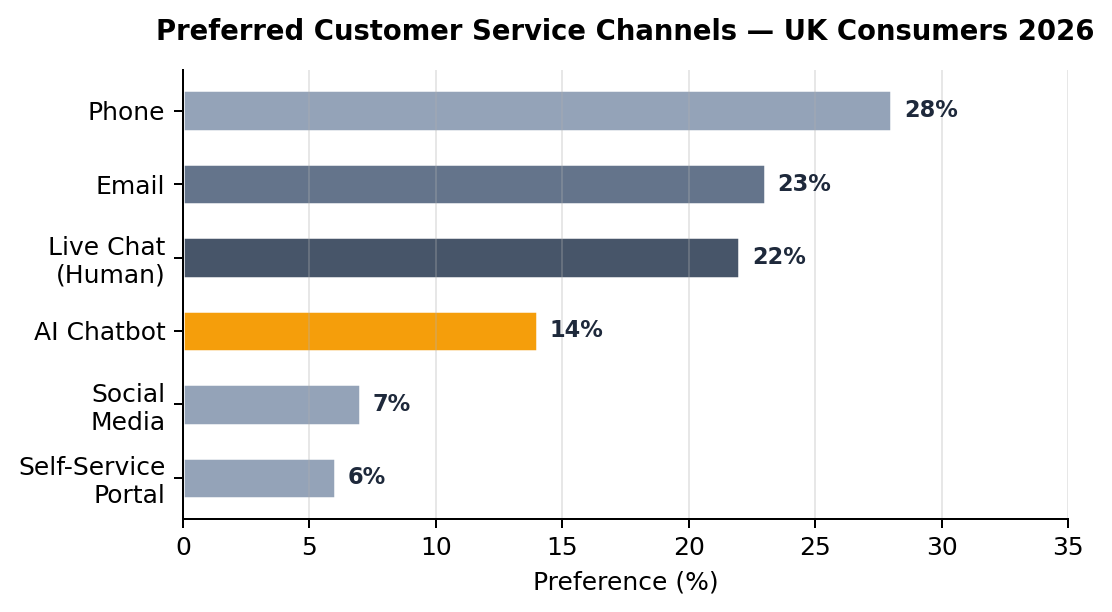
The generational dimension makes this even more urgent. Among consumers aged 18 to 34, preference for AI chatbots as a support channel has already overtaken email. These aren’t customers who tolerate waiting 24 hours for a reply. They grew up with instant messaging, and they expect the businesses they buy from to communicate the same way. Companies that can’t meet that expectation don’t get a second chance — they get abandoned for a competitor who can.
What Modern AI Chatbots Actually Do
The word chatbot still triggers images of clunky menu trees and frustrating loops of “I don’t understand your question.” That reputation is outdated by at least three years. The current generation of AI chatbots, built on large language models, can hold genuinely useful conversations. They understand context, remember earlier parts of the exchange, handle complex multi-part queries, and even detect emotional tone to adjust their responses — escalating to a human agent when frustration is detected rather than continuing to offer scripted answers.
For UK businesses specifically, multilingual capability matters more than most realise. London alone has over 300 languages spoken within its boundaries. A tourism company in Edinburgh, an e-commerce brand shipping to the EU post-Brexit, a SaaS company targeting European markets — all of them need customer support in multiple languages. Hiring multilingual support staff for each language is prohibitively expensive, often costing £25,000 to £35,000 per employee per year before training and management overhead. One solution that handles this well supports conversations in 95 languages across both text and voice channels, solving the multilingual support problem at a fraction of the cost of hiring even a single additional team member.
The Numbers That Matter
Talk of AI transformation is easy. The question business owners actually care about is: does it work, and what does it cost? The evidence from UK SMEs that adopted AI chatbots in 2025 is surprisingly clear. Response times dropped from an average of 24 minutes to under 3 minutes. Support costs fell by 55% within six months. Customer satisfaction scores rose by 16 percentage points. And lead conversion rates more than doubled, primarily because prospects received instant answers during the consideration phase rather than waiting until the next business day when their buying impulse had faded.
Perhaps the most overlooked metric is after-hours coverage. Before chatbot implementation, the average UK SME handled only 15% of customer queries outside standard office hours. After implementation, that figure reached 95%. This matters more than it might appear — 38% of online purchases in the UK happen between 7pm and midnight, and a further 12% happen on weekends before 9am. Every unanswered query during those windows is a potential sale walking out the door. Businesses that want to quantify this impact can use built-in analytics and conversation logs to measure exactly how many leads and sales their chatbot captures when the human team is offline.
Implementation Without the Headaches
The practical concerns around chatbot adoption are legitimate, and dismissing them would be dishonest. Business owners worry about the bot giving wrong answers, frustrating customers with robotic responses, or creating a cold and impersonal experience that damages the brand they’ve spent years building. These risks are real, but they are manageable with the right approach.
The businesses that see the best results follow three principles. First, they define clear boundaries — a chatbot should handle the 80% of queries that are repetitive and predictable, such as order status, return policies, product specifications, and pricing questions. Complex or emotionally charged issues should escalate to a human automatically, with full context passed along so the customer doesn’t have to repeat themselves. Second, they train the bot on their actual data. A generic chatbot underperforms; one trained on your specific FAQ, product catalogue, and historical customer conversations dramatically outperforms because it speaks in your brand’s voice about your specific products. Third, they monitor and iterate. The first week of any deployment is never perfect. The businesses that achieve the strongest results treat their chatbot as a living system, reviewing transcripts weekly and refining responses based on real interactions.
The Window Is Still Open
Right now, only about 22% of UK SMEs with fewer than 50 employees have adopted AI chatbots. That means the majority of small businesses are still losing leads to slow response times, still paying staff to answer the same ten questions hundreds of times per month, and still going dark for 16 hours every day while their customers shop online.
Sarah, the Bristol skincare founder, deployed her chatbot in February. By April, her return rate had dropped to 8%. Her one-star reviews about slow responses stopped almost entirely. And she reclaimed roughly 20 hours per week that she had been spending on repetitive customer queries — hours she now puts into product development and marketing. The total cost of her chatbot solution is less than what she was paying a part-time virtual assistant who could only work in English.
The question for UK businesses isn’t whether AI chatbots will become standard — that outcome is already certain. The question is whether you will adopt one while it still provides a genuine competitive advantage, or whether you will wait until every competitor in your space has one and the edge has disappeared entirely. For most businesses, the answer to that question will determine more about their growth over the next three years than any other single decision they make.